
Earth Building with Sigi Koko
Learning through hands, place, and real materials
In 2025, Earth School children had the opportunity to learn and practice earth building with leaders in the field, Sigi Koko and Delia Bellaby. Through a series of earth building workshops at Mangaroa Farms, children explored natural building methods while developing understanding across science, maths, engineering, and ecological design — all through embodied, hands-on experience.
Learning in practice: Earth building at Mangaroa Farms
The learning began with the first-ever workshop in Aotearoa New Zealand by internationally acclaimed earth builder Sigi Koko, and culminated in the creation of a small cob “fairy village” led by Delia Bellaby, Chair of the Earth Building Association of New Zealand (EBANZ).
Across these workshops, children were introduced to a range of natural building techniques and materials, including:
Cob — sculptural, hand-formed earthen building
Adobe bricks — sun-dried earthen blocks
Rammed earth — compacted earthen walls
Earth plasters — natural protective and decorative finishes
They then worked together to build their own small earthen wall, combining adobe and cob and testing their ideas through doing.
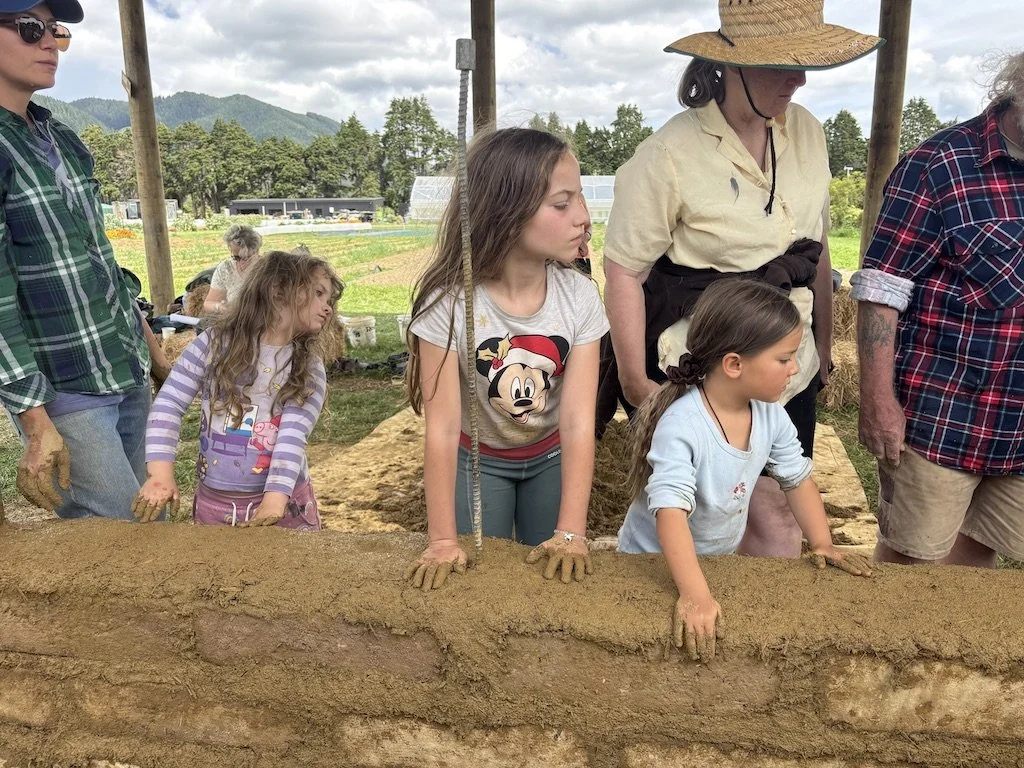
Earth School Aotearoa children building an adobe wall at Sigi Koko workshop held at Mangaroa Farms.
Learning from the land
Materials were harvested directly from the land at Mangaroa Farms.
Clay
Fibre (plant-based binding materials)
Aggregate (sand, grit, and small stones)
Working with materials sourced from place helped children understand that buildings are not separate from nature — they are made of it. Learning became sensory, relational, and deeply grounded.
Children’s reflections
“We loved having our hands and feet in the clay.”
“Why aren’t all buildings made with natural materials?”
What children learned
Through mixing, testing, and building, children discovered that many different building materials can be created using the same basic ingredients — simply by changing the ratios:
To increase strength, add more aggregate (larger particles).
To increase stretch and flexibility (tensile strength), add longer fibres.
To increase stickiness and binding, add more clay and water.
This was mathematics and engineering made tangible — concepts learned through the body, collaboration, and experimentation.
Why earth building is such a powerful learning resource
Earth building offers a rich context for integrated learning because it:
Brings together science, maths, engineering, art, and ecology naturally
Supports embodied learning rather than abstract instruction
Encourages real-world problem solving and iteration
Strengthens ecological literacy through local materials and low-impact design
Helps children see buildings, materials, and systems differently in everyday life
Children experienced themselves as capable makers — able to shape, test, and improve real structures in relationship with land and one another.
Continuing the learning
Families and educators often extend this learning by experimenting with clay and sand at home, noticing different building styles in their local area, or exploring natural and earth building traditions from diverse cultures.
For those wishing to explore further, the Earth Building Association of New Zealand (EBANZ) offers resources, courses, and guidance for learners, builders, and designers across Aotearoa.
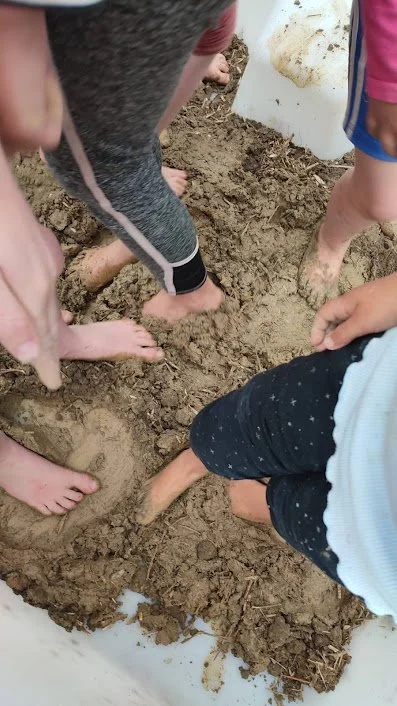
Feet in the Soil
Earth School Aotearoa children mixing cob with their feet after adding clay, fibre, and aggregate sourced from the land at Mangaroa Farms.